THE KING WHO CHOSE STRAW OVER A THRONE
There’s an old parable by Soren Kierkegaard called “The King and The Maiden.”
A powerful king falls in love with a humble maiden from his kingdom, but faces a dilemma: How can he win her heart? If he comes to her in royal robes, flanked by guards and dripping with glory, she might say yes. But would it be love, or fear? Would she love him, or only his power?
The king considers his options. He could elevate her—bring her to the palace, dress her in fine clothes. But she would always feel the gap between them—aware that he lifted her up, conscious of the debt she could never repay.
So, the king makes a radical choice. He sets aside his crown, his royal garments, his palace. He descends to her level. He becomes a commoner, lives among the people, works with his hands, feels hunger and fatigue. He doesn’t announce who he is. He simply lives beside her, serves alongside her, and loves her as an equal.
Only then can she truly choose. Only then can love be real.
That is Christmas.
The King of glory didn’t shout down from heaven.
He came down and became one of us.
He didn’t send advice or a message from a distance.
He brought Himself.
How Do You See God?
How do you picture God?
Is He far away and unimpressed—a distant judge keeping score of your failures? Is He vague and abstract—a cosmic force that doesn’t really care about your life? Or is He near enough to feel your breath and strong enough to carry your burdens?
Christmas confronts us with the most staggering paradox in history: God became a human baby—not pretending, not appearing, but truly entering our world in flesh and blood.
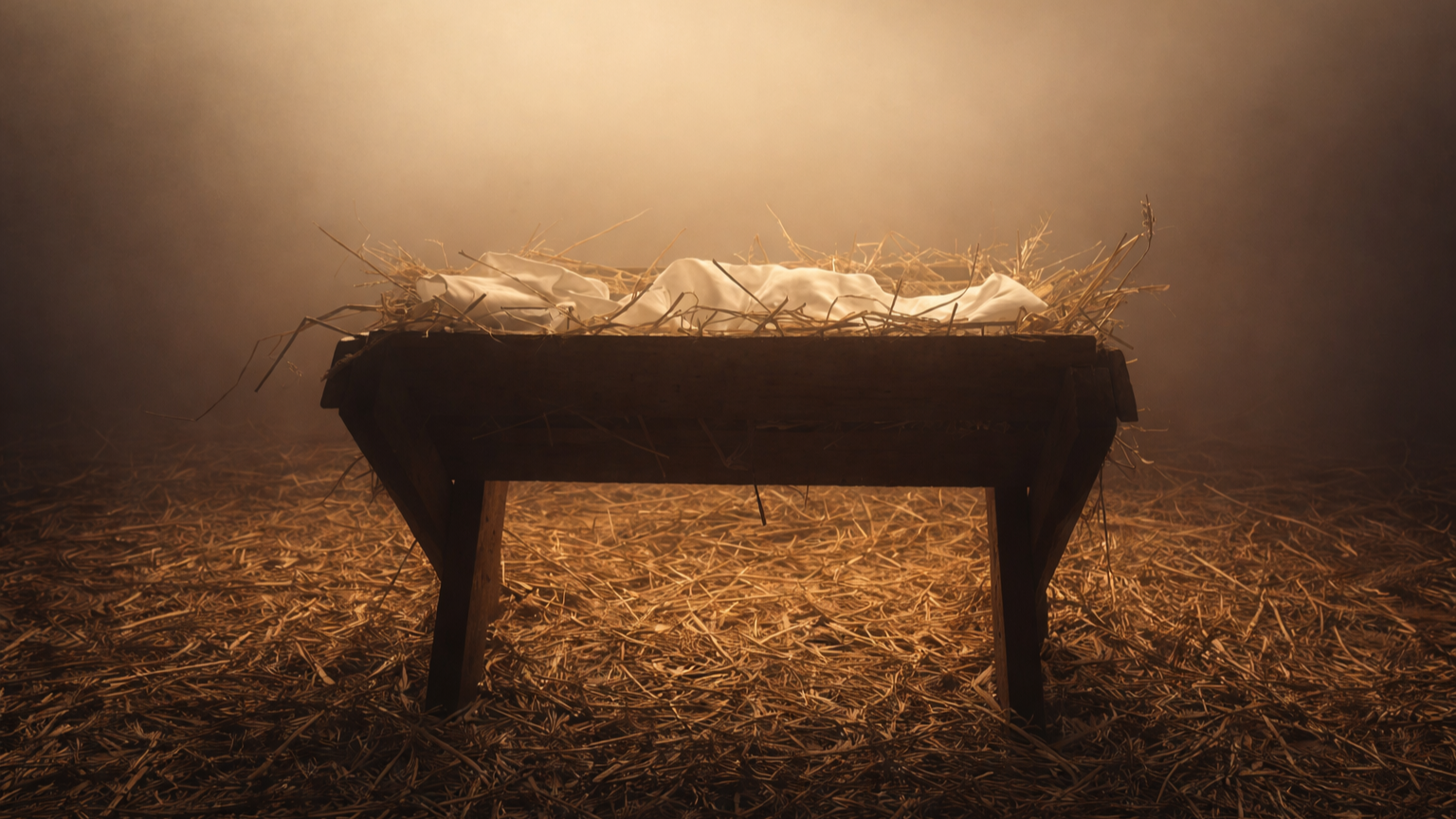
Majesty moved into a manger.
This isn’t just a nice story about a baby born in humble circumstances. This is the eternal God, the Creator of everything, choosing to become helpless, vulnerable, and small. The question is: Why? And what does it mean for you?
In the Beginning Was the Word
The apostle John starts his gospel not in Bethlehem, but before time itself:
“In the beginning was the Word, and the Word was with God, and the Word was God. He was with God in the beginning. Through him all things were made; without him nothing was made that has been made. In him was life, and that life was the light of all mankind” (John 1:1-4).
John wants us to understand something crucial before we get to the manger: This baby wasn’t just anyone.
“In the beginning was the Word...” John starts before Bethlehem—before time. The Word represents God’s nature, wisdom, and power. He is eternal. He has always existed.
“...and the Word was with God...” Literally, face-to-face. The Word is distinct from the Father, yet in perfect fellowship with Him.
“...and the Word was God.” Not a lesser divinity. Not a messenger. Not an angel. Fully God.
“Through Him all things were made.” Everything that exists—every star, every mountain, every cell in your body—owes its existence to the One who has always existed.
The baby in the manger was the King of glory.
The World Didn’t Recognize Him
Here’s where it gets uncomfortable. John continues:
“The true light that gives light to everyone was coming into the world. He was in the world, and though the world was made through him, the world did not recognize him. He came to that which was his own, but his own did not receive him” (John 1:9-11).
Why? Why didn’t we recognize Him?
Because we weren’t looking for majesty in a manger. We expected a spectacle. An announcement. A production. We thought God would show up with armies, displays of power, and unmistakable divine credentials.
Instead, He showed up as a baby. In a stable. Born to a teenage girl. Surrounded by animals and shepherds.
You wouldn’t normally go looking for the Creator among His creation.
You wouldn’t search for the King among commoners.
You wouldn’t expect majesty in a manger.
And that’s why we missed Him. We’re still missing Him.
The Word Became Flesh
Then John hits us with one of the most extraordinary statements in all of Scripture:
“The Word became flesh and made his dwelling among us. We have seen his glory, the glory of the one and only Son, who came from the Father, full of grace and truth” (John 1:14).
John chooses a very specific word here: “became.” In Greek, it’s egeneto—a strong verb that means a real transformation occurred. Not “seemed to be.” Not “appeared as.” Not “wore a costume.”
The eternal Son became human. Real body. Real mind. Real emotions. Real tears.
The word for “dwelt” literally means He “pitched His tent” or “tabernacled” among us. This echoes the Old Testament, where God’s presence dwelt in the tabernacle with Israel. Jesus is the same God who inhabited the temple and saved His people from Egypt—now living among us in human flesh.
Think about what this means: The infinite entered the finite. The Creator joined His creation. The distance between holy God and broken humanity disappeared in Christ.
The Paradox at the Center of Our Faith
This is the paradox that defines Christianity: King and stable. Throne and straw.
He deserved a palace but chose poverty.
He deserved worship but accepted rejection.
He deserved glory but embraced humility.
Kierkegaard’s king took off his crown to win the maiden’s heart. Our King went further—He took on our skin. He didn’t just dress down; He became one of us. And He didn’t do it from a safe distance. God didn’t just come near—He came in. He took a body, a mind, emotions, and a family. He experienced hunger, thirst, exhaustion, temptation, misunderstanding, loneliness, and grief.
When you toss and turn at 2 a.m., He understands. When you face temptation, He sympathizes and helps. When you feel abandoned, He knows what that’s like.
This changes everything about how we relate to God.
He Came Low to Lift Us Up
Here’s what John is driving us toward:
“Yet to all who received him, to those who believed in his name, he gave the right to become children of God—children born not of natural descent, nor of human decision or a husband’s will, but born of God” (John 1:12-13).
The King who left His palace wants to live in your heart. Christmas isn’t just a story to admire from a distance. It’s not just a nice holiday tradition or a heartwarming tale. It’s a Savior to receive.
C.S. Lewis put it perfectly: “The Son of God became a man to enable men to become sons of God.”
He came down so we could come up.
He became human so we could become His children.
He took on our flesh so we could share in His divine nature.
Why This Matters for You
Some of us picture God as distant—pure authority with no warmth. A judge who’s waiting for us to mess up. A cosmic scorekeeper who’s never satisfied.
Others treat Him like a sentimental buddy—all warmth with no weight. A cosmic therapist who just wants us to feel good about ourselves. Santa Claus in the sky.
Christmas corrects both.
In the manger stands majesty—He is God. Eternal. All-powerful. Holy. Worthy of worship.
In the manger lies mercy—He is with us. Near. Gentle. Understanding. Full of grace.
God is gentle and glorious. Meek and mighty. Approachable and sovereign.
You don’t have to choose between a God who is powerful and a God who is present. Between a God who is holy and a God who is helpful. Between a God who is transcendent and a God who is tender. Christmas shows us that God is both—fully and perfectly.
The Invitation
The manger was just the beginning. That baby grew up and lived a perfect life. He healed the sick, loved the outcast, challenged the proud, and welcomed the broken.
Then He went to a cross. The King who came down kept descending—all the way to death. He took on our sin, our shame, our death, so that we could have His life, His righteousness, His eternal throne.
Three days later, He rose from the grave—proving that death couldn’t hold the Author of life.
And now He offers you the same invitation He offered two thousand years ago: “Receive Me. Believe in My name. Become a child of God.” Not through your own effort. Not through your family background. Not through religious performance. “Born of God.” A supernatural transformation. A new identity. A new family. A new life.
Take Action
Let me ask you directly: Have you received Him? Have you stopped admiring the story from a distance and actually invited the King into your life?
Perhaps you’ve been around Christianity your whole life. You know the stories. You celebrate the holidays. You might even go to church. But you’ve never personally received Christ. You’ve never said, “Jesus, I need You. I believe You’re the Son of God who came to save me. I’m receiving You right now.” If that’s you, today can be your day. Christmas isn’t just about remembering what happened two thousand years ago. It’s about responding to what God is offering you right now.
Or you may have received Christ years ago, but you’ve forgotten what it means. You’ve drifted back into seeing God as distant or demanding. You need to remember: The God who came to a manger is the same God who lives in your heart right now. He’s not disappointed in you. He’s not far away. He’s not waiting for you to get your act together before He’ll draw near. He’s already near. He already chose you. He already came down. Now He’s inviting you to come home.
If you’ve never received Christ, tell Him: “Jesus, I believe You’re the Son of God who came to save me. I need You. I’m receiving You right now as my Savior and King.”
If you already know Christ, tell Him: “Thank You for coming near. Help me to see You not as distant or demanding, but as the gentle, glorious King who chose straw over a throne because You loved me.”
That’s it.
Just you and the God who came down.
The majesty who moved into a manger.
The King who wants to live in your heart.
All for Jesus,
Brad D. Jenkins
P.S. — If this has been helpful, please send me a message at brad@bradjenkins.me and let me know. My writing aims to help people enjoy a vibrant relationship with Jesus, and it is an honor to be on this journey with you. To read previous newsletters or to sign up so that you don’t miss future posts, visit www.bradjenkins.me/blog.